
AI search & GEO
How Do AI Search Engines Find Information and Generate Answers?
Published October 14, 2026 · 9 min read · Last updated October 14, 2026
Zeina Torbey · LinkedIn
Table of contents
- The process at a glance
- 1. AI Search vs. Traditional Search: What's the Difference?
- 2. From Question to Answer: How AI Search Works
- How query fan-out might work
- 3. Why AI-Generated Answers and Citations Can Be Wrong
- Four reasons to verify an AI-generated answer
- 4. What Varies Between AI Search Products?
- 5. What Marketers Can Do to Make Their Content Discoverable
- Five practical priorities for content teams
- Frequently Asked Questions
- Conclusion: From Search Results to Generated Answers
- Sources and further reading
When you ask an AI search engine a question, it can do more than return a list of webpages. Depending on the tool, it may explore several related searches, find relevant information from different sources and use a language model to generate a direct answer with supporting links.
For marketers, this changes how customers discover and evaluate products. A brand's website is no longer necessarily the final destination of every search: its information may also contribute to an answer generated elsewhere.
Research published by Harvard Business Review in 2025 examines the implications of LLM-powered search for brand discovery. McKinsey's 2025 research likewise explores how AI-powered search is changing consumer research and marketing strategy. These developments make it useful to understand what happens between a customer's question and the answer they receive.
The process at a glance
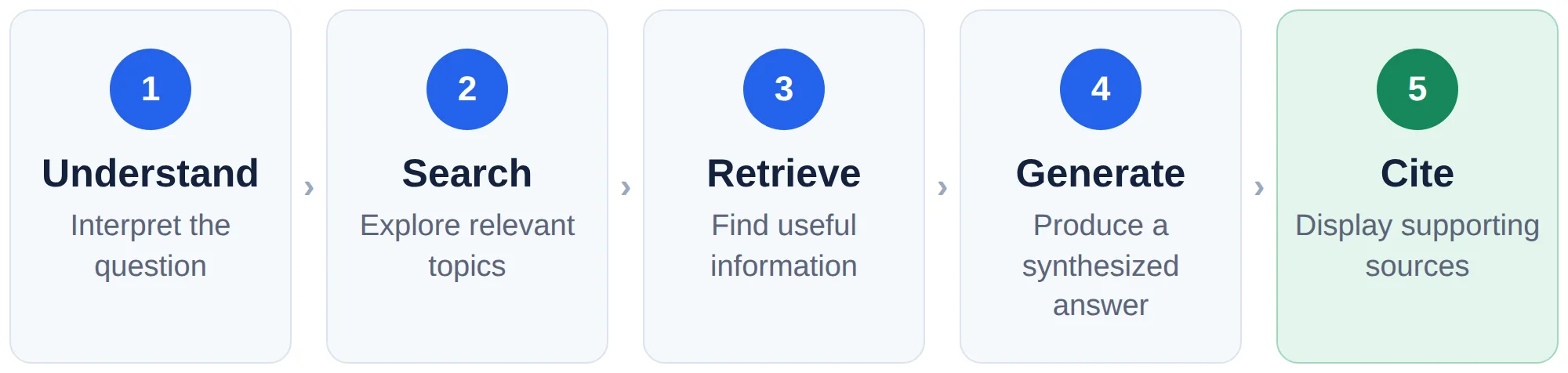
A simplified model of retrieval-enabled AI search. Actual products may combine, repeat or omit individual steps.
1. AI Search vs. Traditional Search: What's the Difference?
Traditional search engines typically help users discover information through a ranked list of results. People open webpages, compare sources and draw their own conclusions.
AI search can perform part of that work for them. It retrieves relevant information and uses a language model to create a synthesized response, often accompanied by links to supporting sources.
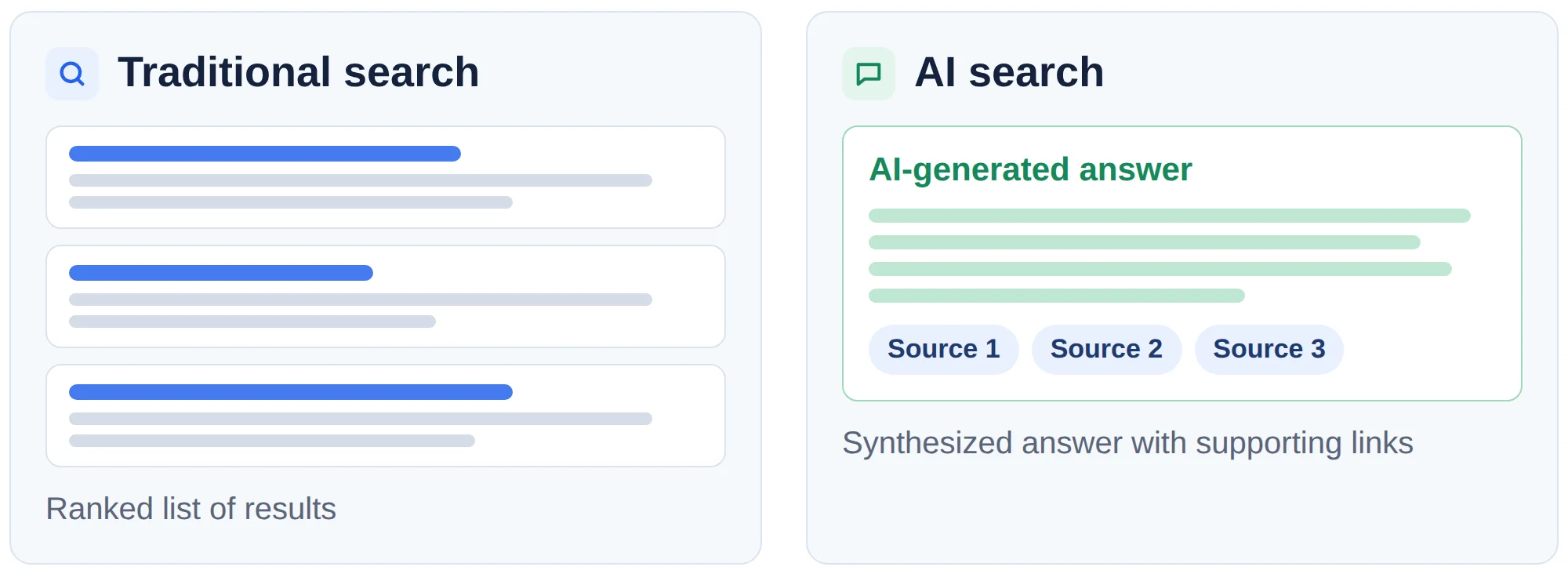
Users receive an answer they should verify.
Traditional search | AI search | |
|---|---|---|
Typical output | Ranked search results | Generated answer, often with links |
User's task | Visit and compare sources | Review and verify the synthesis |
Interaction | Search and refine queries | Ask questions and follow up |
Information presentation | Primarily individual results | Information may be combined across sources |
The two experiences increasingly overlap. Google's AI Overviews and AI Mode, for example, build on its broader search infrastructure while introducing generated answers and supporting links.
Google Search Central explains its AI search features.
2. From Question to Answer: How AI Search Works
To understand the process, imagine a potential customer asking:
EXAMPLE QUESTION

This question will guide us through the five steps.
Step 1: Understand the user's question
The system first needs to interpret what the user wants.
In our example, the person is not simply looking for CRM software. They need a product that suits a small agency and meets an affordability requirement.
A useful answer would need to consider:
Pricing and subscription limits.
Features relevant to marketing agencies.
Integrations with existing tools.
Ease of use for a small team.
An AI system may also use the conversation's context. If the user follows up with “Only show me tools that integrate with Gmail,” that new requirement can help refine the next answer.
Understanding intent is important because the best response depends on the user's actual needs, not just the individual words in the query.
Step 2: Search for relevant information
A complex question may require more than one search.
Some AI search systems use a technique called query fan-out: they explore several related searches to gather information about different aspects of the original question. Google documents this as a capability of its AI search features, not a step that occurs in every search.
How query fan-out might work
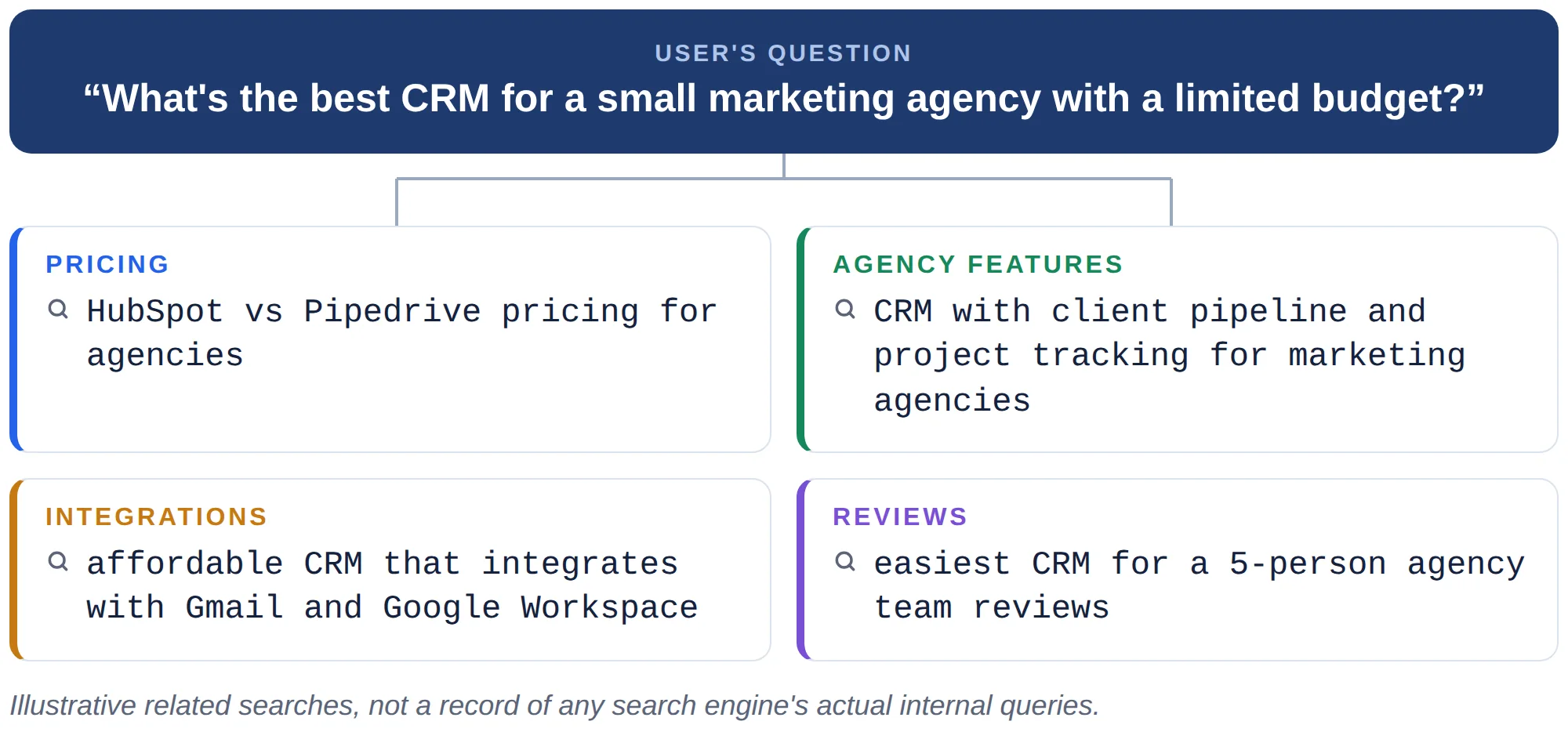
By exploring these related questions, a system can gather information that a single narrow search might miss.
For content professionals, this illustrates why a topic should be covered according to customers' genuine information needs. A buyer researching CRM software may need more than a general product description.
Step 3: Find and select useful information
Once the system has searched, it needs to identify information that can help answer the question. This is called retrieval.
Think of retrieval as finding useful evidence. For our CRM example, different sources can contribute different information.
Information source | Example | What it can contribute |
|---|---|---|
Official website | CRM pricing page | Published plans and prices |
Product documentation | Integration guide | Available features and requirements |
Independent publication | CRM comparison | External analysis |
Community discussion | User experiences | Reported advantages and limitations |
Some retrieval systems work with relevant passages from documents rather than processing every webpage in full. They may divide long documents into smaller sections to locate useful information.
There is no need to understand the technical details of this process to grasp the key distinction: finding a webpage does not automatically mean its information will be used in the answer.
Research on OpenScholar, published in Nature in 2026, provides an example of a specialized system that retrieves scientific literature and uses it to produce referenced answers. It demonstrates the broader retrieval-and-generation approach, but does not establish how every commercial AI search engine operates.
Step 4: Generate an answer
After retrieving relevant information, a language model can use it to create a response.
This approach is commonly called retrieval-augmented generation (RAG). In plain English, it means giving a language model relevant external information to help it answer a question.
In our CRM example, the model might combine product features, published prices and independent assessments into a comparison organized around the user's priorities.
Instead of presenting disconnected search results, it could explain which products meet the specified requirements and where their limitations differ.
The model still generates new text. It is not simply copying source material, which is why errors can occur even when the retrieved information is accurate.
! KEY CONCEPT Retrieval provides relevant information. Generation turns that information into a response. The quality of the final answer depends on both. |
|---|
Step 5: Provide supporting sources
Many AI search tools include citations or supporting links, allowing users to investigate the information behind an answer.
However, three outcomes must be distinguished.
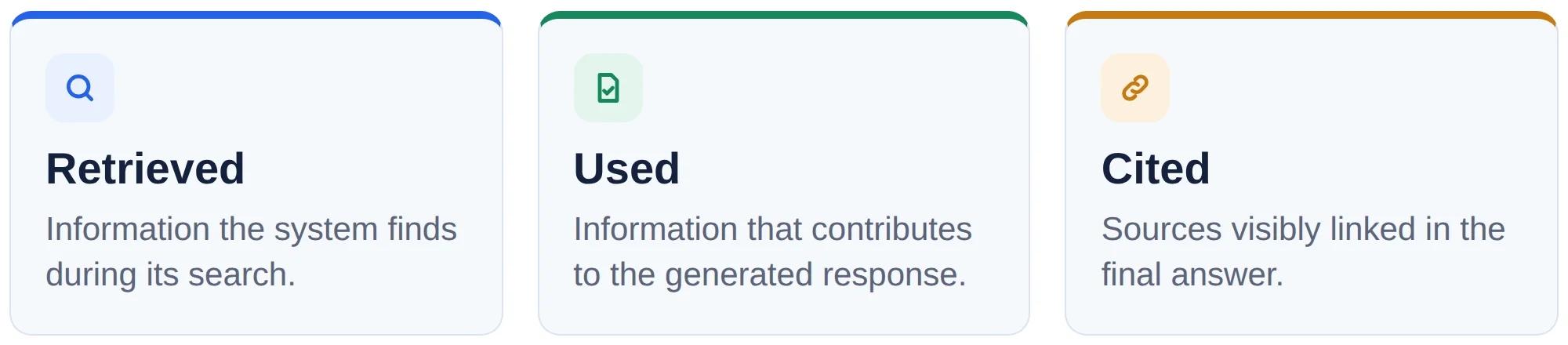
A webpage may be retrieved without contributing to the response. Its information may contribute without the page receiving a visible citation. Or the page may be cited as a supporting source.
These distinctions matter when marketers evaluate AI search visibility. Being discoverable, influencing an answer and appearing as a citation are not interchangeable results.
3. Why AI-Generated Answers and Citations Can Be Wrong
AI search can save users time, but a well-written answer is not necessarily a correct one. Errors can occur when the system searches for information, selects sources or generates its response.
Four reasons to verify an AI-generated answer
Conflicting sources | Official product documentation and independent reviews may present different perspectives. An AI-generated summary can overlook those differences. |
|---|---|
Incomplete information | The system may miss an important source or fail to retrieve the details needed to answer the question fully. |
Outdated information | A CRM provider may have changed its pricing or removed a feature. An answer based on older information could be misleading. |
Incorrect synthesis | A model may misinterpret a source, confuse monthly and annual prices or make a claim that the cited material does not support. |
4. What Varies Between AI Search Products?
The five-step model explains common concepts, but AI search products do not all work in the same way. Their retrieval methods, interfaces and citation practices can differ.
Product | Documented experience | What users should know |
|---|---|---|
Google AI Mode | AI-generated responses integrated with Google's search experience; may use query fan-out | Supporting links and answers can differ from conventional search results |
ChatGPT Search | Conversational answers with web search and source links | Users can refine a question through follow-up prompts |
Perplexity | Answer-oriented search with linked sources | Source presentation and answers can differ from other products |
For marketers, this means a brand's visibility should not be judged from a single prompt on a single platform. The answer may change depending on the user's wording, the product and the information available at the time.
5. What Marketers Can Do to Make Their Content Discoverable
Understanding AI search does not require abandoning traditional SEO. It means ensuring that useful, accurate information is available to both customers and the systems that help them find answers.
The marketing implications of LLM-powered discovery are discussed in Harvard Business Review's 2025 article, Forget What You Know About Search. Optimize Your Brand for LLMs., and McKinsey's 2025 report, New Front Door to the Internet: Winning in the Age of AI Search. Both provide a business perspective on the changing customer discovery process rather than a guaranteed formula for AI citations.
Five practical priorities for content teams
Priority | What to do | CRM example |
|---|---|---|
Discoverability | Maintain accessible, indexable pages | Make pricing and feature pages easy to find |
Clarity | Use descriptive headings and direct answers | Explain what each subscription includes |
Completeness | Address genuine customer questions | Cover integrations, onboarding and limitations |
Accuracy | Keep important facts current and verifiable | Update prices and feature availability |
Broader visibility | Understand relevant independent and community sources | Monitor reviews and customer discussions |
Make your information accessible
Start with established SEO fundamentals. Important pages should be discoverable, technically accessible and useful to visitors.
Google states that its existing SEO guidance remains relevant to AI Overviews and AI Mode. There is no separate AI-specific markup requirement for appearing in these features. Eligibility, however, does not guarantee inclusion in an AI-generated answer.
Write clear, self-contained sections
Organize information around real customer questions. Use descriptive headings, concise explanations and comparison tables when they help readers make decisions.
For example, a CRM pricing page should make it easy to identify the cost of each plan, the features included and any important restrictions.
This is an editorial recommendation, not a technical chunking formula. There is no established paragraph length or page format that guarantees an AI citation.
Cover related questions without multiplying unnecessary pages
Query fan-out illustrates why a broad customer question can involve several related information needs.
A useful CRM guide might address pricing, integrations, agency workflows and implementation considerations together. That does not mean creating a separate page for every possible search variation.
The objective is to satisfy the user's information needs with genuinely helpful content, not to manufacture pages solely to target hypothetical AI searches.
Support claims with verifiable information
Specific, well-supported information is more useful than vague marketing statements.
If your product integrates with a particular platform, explain what the integration does and which plans support it. If you publish a comparison, disclose the criteria used. If you conduct original research, explain the methodology.
Accuracy also requires maintenance. Review product specifications, prices and other time-sensitive information regularly.
Look beyond your own website
A brand's website is one source among many. Independent publications, product comparisons and community discussions can also shape the information available about a product.
That makes it useful to understand what customers and third parties are saying about your offering. Accurate public information and credible independent coverage can complement your owned content, although neither guarantees inclusion in an AI answer.
There is no guaranteed AI citation formula Strong SEO, clear content and credible sources support information discovery and usefulness. They do not ensure that a particular AI search engine will retrieve, use or cite a page for a given question. |
|---|
Frequently Asked Questions
Do AI search engines always search the live internet?
No. Their behavior depends on the product, its available tools and the question. Some answers incorporate current web information, while others may rely on information already available to the model or supplied in the conversation. Check sources and dates when freshness matters.
Does ranking first in Google guarantee an AI citation?
No. Traditional search ranking and selection for an AI-generated answer are different outcomes. Google's AI features may explore related searches and display supporting links that differ from conventional results. A strong ranking does not guarantee a citation.
Conclusion: From Search Results to Generated Answers
AI search changes how people discover information by bringing retrieval and answer generation into the same experience. A system may interpret a question, explore related topics, find useful information and generate a response with supporting links.
For marketers, the distinction between information being retrieved, used and cited is especially important. Each represents a different stage, and none is guaranteed by the others.
The practical priority remains creating accurate, accessible and genuinely useful content that addresses customers' real questions. Understanding how AI search works helps content teams make better editorial decisions without chasing unsupported optimization shortcuts.
Sources and further reading
The article draws on 2025–2026 business research and technical documentation.
Harvard Business Review (2025), “Forget What You Know About Search. Optimize Your Brand for LLMs.” — marketing implications of LLM-powered discovery.
https://hbr.org/2025/06/forget-what-you-know-about-seo-heres-how-to-optimize-your-brand-for-llms
McKinsey (2025), “New Front Door to the Internet: Winning in the Age of AI Search.” — consumer research and implications for marketing.
Let’s discuss your strategy
Identify the search visibility and content opportunities for your business.