
B2B content strategy
How B2B Buyers Use ChatGPT to Compare and Shortlist Suppliers
Published October 14, 2026 · 8 min read · Last updated October 14, 2026
Zeina Torbey · LinkedIn
Table of contents
- 1. How are B2B buyers using generative AI?
- 2. How can ChatGPT help buyers compare and shortlist suppliers?
- 3. Which sources does AI use to evaluate B2B suppliers?
- 4. How should buyers verify AI-generated supplier comparisons?
- 5. How can B2B suppliers improve their visibility during AI-assisted evaluations?
- 1. Publish information that answers purchasing questions
- 2. Support claims with evidence
- 3. Build visibility beyond the company website
- 6. What are the limitations of ChatGPT in supplier selection?
- 7. Frequently asked questions
- 1. Can ChatGPT identify new B2B suppliers?
- 2. Do B2B buyers use ChatGPT mainly for supplier comparison?
Generative AI is changing how B2B buyers evaluate potential suppliers. While traditional channels remain important for identifying vendors, tools such as ChatGPT can help buyers compare offerings, organize technical information and prepare purchasing decisions. Understanding this shift is essential for companies seeking visibility throughout the B2B buying journey.
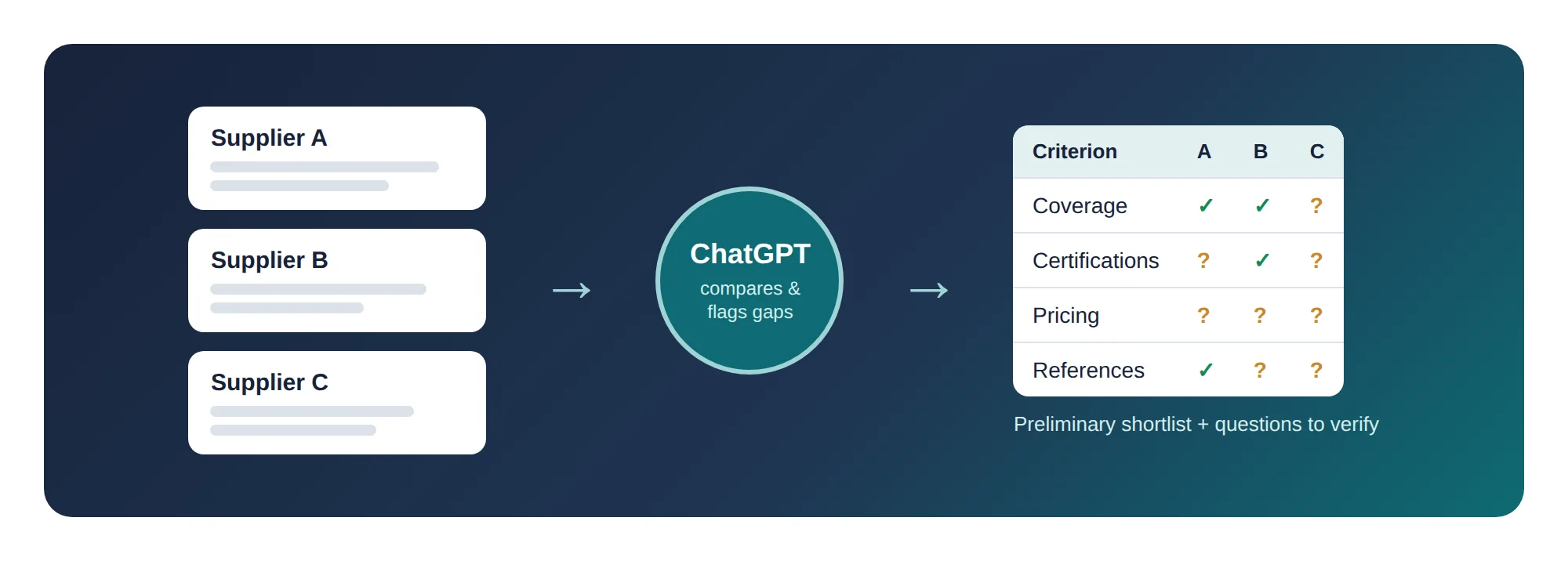
This distinction matters for suppliers. Being discovered through traditional search, industry directories or professional recommendations is only one part of the challenge. Companies must also provide clear, comparable and credible information that buyers can use during AI-assisted evaluations.
This article examines how ChatGPT fits into supplier research, which information sources influence AI-generated answers and how buyers can verify their findings before making purchasing decisions.
1. How are B2B buyers using generative AI?
Generative AI supports several stages of the B2B purchasing process, from initial research to supplier evaluation. However, its role varies depending on the buyer's needs and the stage of the journey.
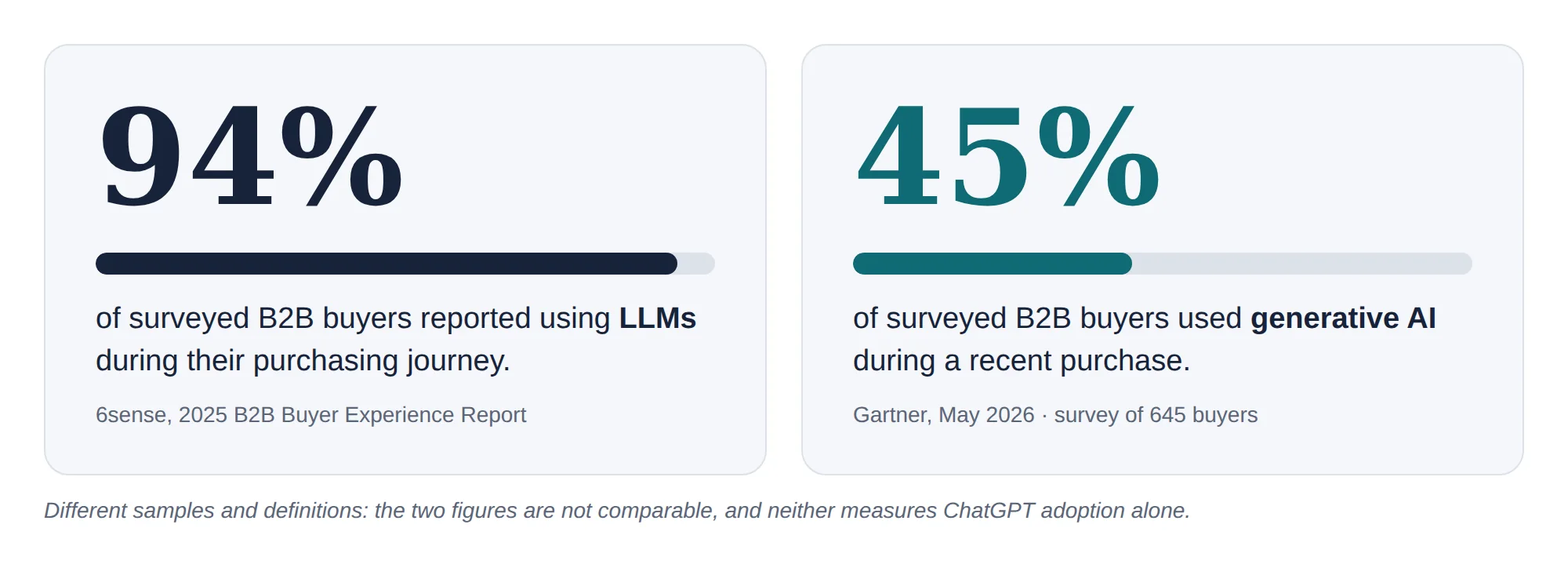
Research indicates that comparison and information synthesis are particularly important applications.
What recent B2B research reveals
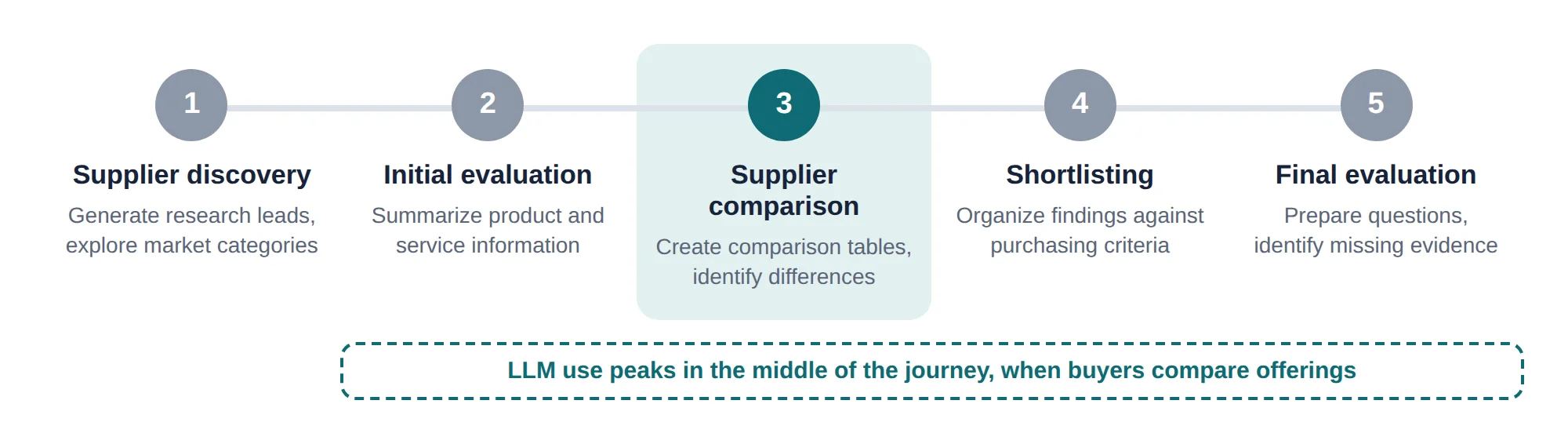
Discovery versus comparison: two different uses of AI
A buyer searching for potential suppliers has different information needs from one comparing vendors already under consideration.
Buying stage | Buyer's objective | Potential use of ChatGPT |
|---|---|---|
1. Supplier discovery | Identify potential vendors | Generate research leads and explore market categories |
2. Initial evaluation | Understand supplier capabilities | Summarize product and service information |
3. Supplier comparison | Evaluate competing offerings | Create comparison tables and identify differences |
4. Shortlisting | Identify candidates for further evaluation | Organize findings against purchasing criteria |
5. Final evaluation | Validate the preferred candidates | Prepare questions and identify missing evidence |
The table describes potential applications; it should not be interpreted as a measured distribution of ChatGPT usage across purchasing stages.
The distinction between these stages is important. Research on B2B buying behavior indicates that buyers frequently have prior knowledge of potential vendors before conducting detailed evaluations.
ChatGPT can therefore be especially useful as a tool for processing and comparing information rather than simply generating lists of unfamiliar suppliers.
2. How can ChatGPT help buyers compare and shortlist suppliers?
ChatGPT can support supplier evaluation by turning information from multiple documents into a structured comparison. Buyers can use it to organize requirements, identify differences between competing offerings and prepare questions for suppliers.
The following five-step workflow illustrates how AI can be incorporated into an existing procurement process.
Five steps in AI-assisted supplier evaluation
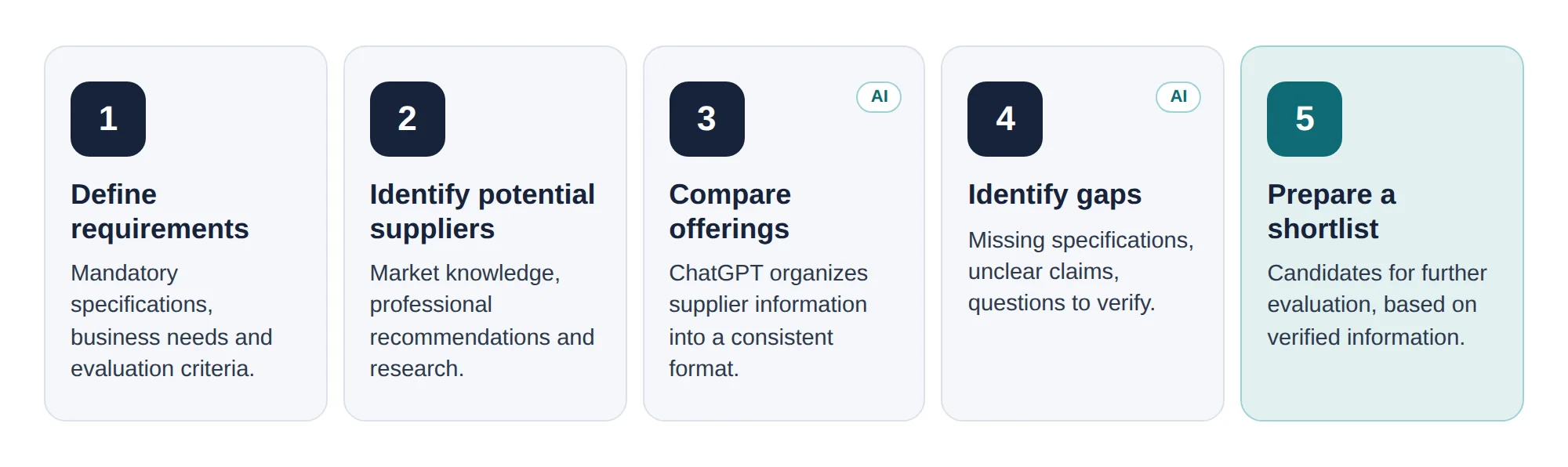
Illustrative workflow. Actual procurement processes vary by organization and purchasing requirements.
Example: comparing three logistics providers
Consider a European manufacturer evaluating three logistics providers. The company needs coverage in France and Germany, express delivery capabilities and relevant industry certifications.
After collecting supplier documentation, the procurement team could use ChatGPT to create an initial comparison.
Criterion | Supplier A | Supplier B | Supplier C |
|---|---|---|---|
Geographic coverage | France and Germany | Europe-wide | France only |
Express delivery | Available | Available | Not specified |
Certifications | To verify | To verify | To verify |
Pricing | Quotation required | Quotation required | Quotation required |
Customer references | To request | To request | To request |
Fictional suppliers and hypothetical capabilities, used solely to illustrate the comparison process. Amber cells show information still to be verified or requested.
This approach makes differences visible while highlighting information that is missing. It also helps buyers prepare more focused supplier discussions instead of relying on incomplete comparisons.
Example ChatGPT prompt |
|---|
“Compare the suppliers in the attached documents against our purchasing requirements. Create a table covering geographic coverage, delivery capabilities, certifications, pricing and customer references. Cite the source for every factual claim, identify missing information and prepare questions for each supplier. Do not invent specifications.” |
3. Which sources does AI use to evaluate B2B suppliers?
AI-generated supplier comparisons may draw on company websites, technical documentation, independent publications, professional directories and customer discussions.
The exact sources depend on the AI system, whether web search is available and the information supplied by the user.
A 2026 industry study provides insight into the types of websites cited in AI-generated answers.
What an analysis of 107 million AI answers reveals
The study compared leading citation sources across three industries: IT and solutions services, consumer goods and communication services.
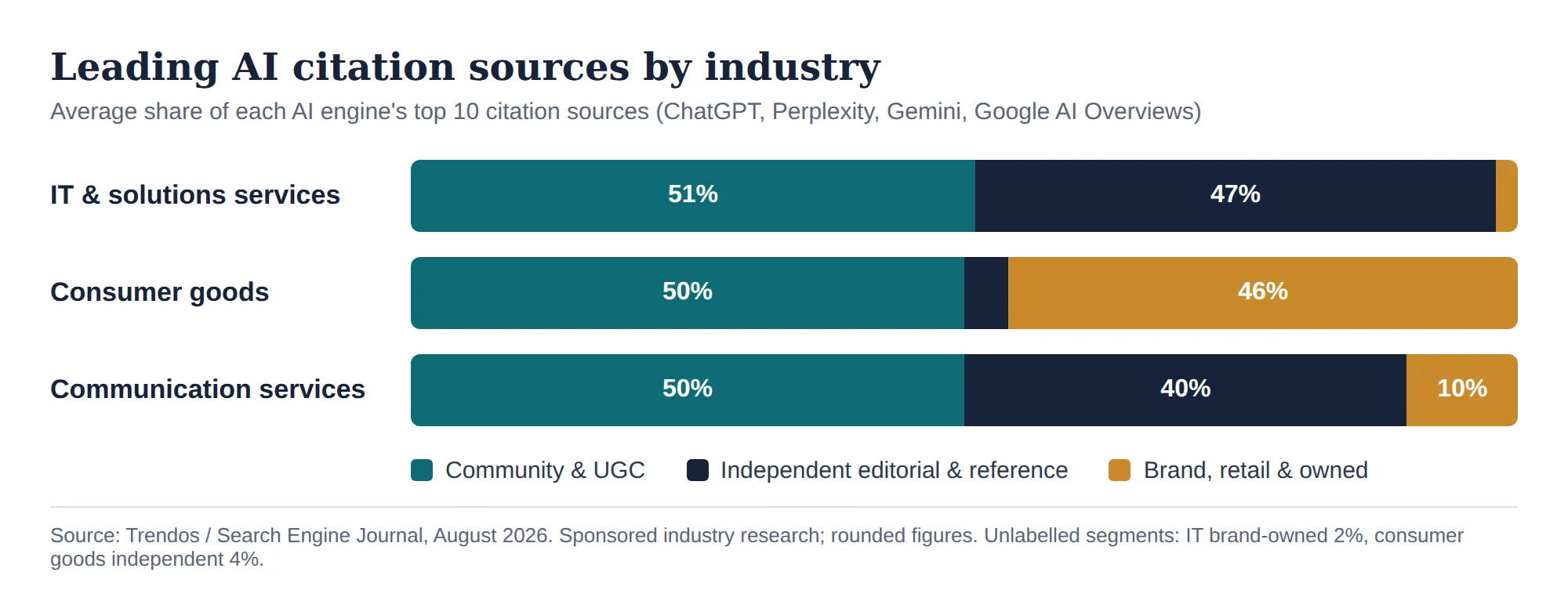
The figures represent the distribution of leading citation sources within the study, not every AI citation or every B2B industry.
In IT and solutions services, community and user-generated content accounted for approximately 51% of leading citations, while independent editorial and reference sources represented 47%. Brand-owned sources accounted for 2%.
The contrast with consumer goods is substantial: brand-owned and retail sources represented 46% of leading citations in that category.
How to read these figures The findings illustrate how AI citation patterns can differ by industry. They do not establish that ChatGPT always uses these proportions when comparing suppliers. The research was sponsored industry research rather than an independent academic study, and its findings should be interpreted within that scope. |
|---|
Three categories of supplier information
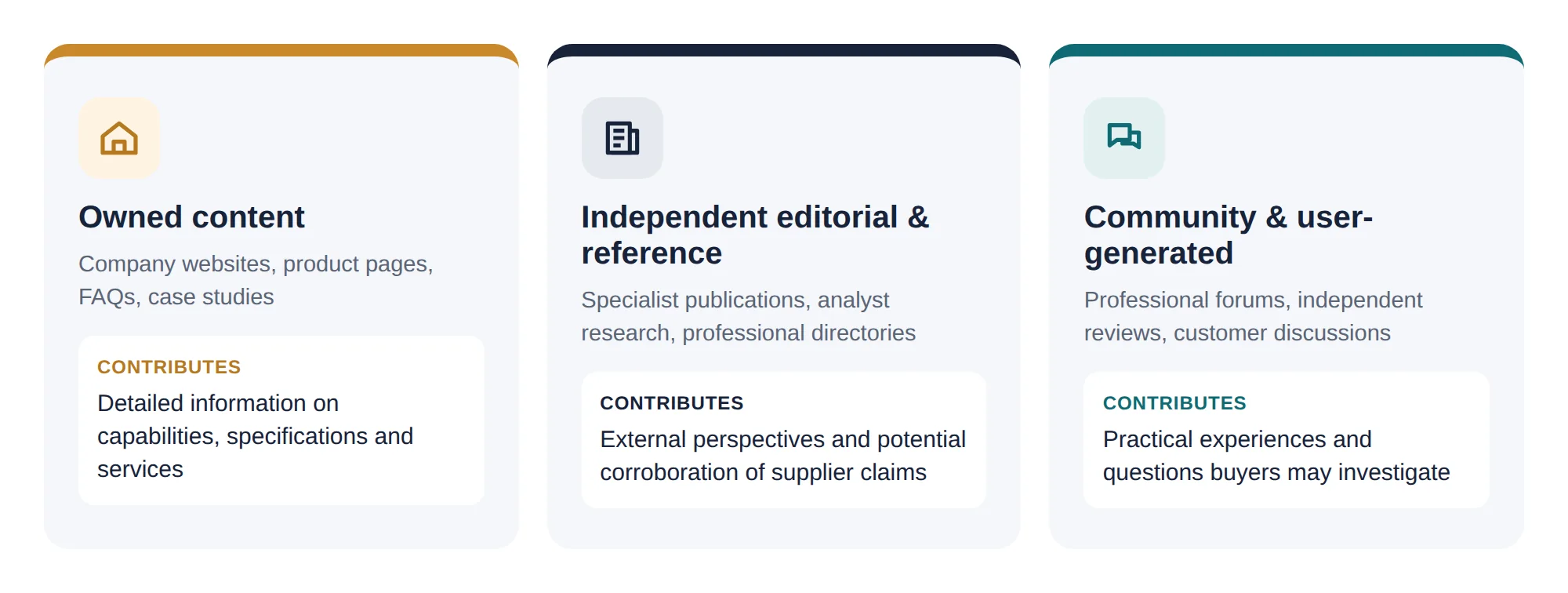
Each category serves a different purpose. A company website may provide the most detailed technical specifications, while an independent review can offer information about implementation experiences. Professional communities may reveal recurring questions about customer support or operational limitations.
Buyers should consider the quality, relevance and recency of individual sources rather than assuming that any category is inherently reliable.
4. How should buyers verify AI-generated supplier comparisons?
AI-generated comparisons can contain outdated information, unsupported claims or incomplete supplier coverage. Important purchasing decisions therefore require verification against original documentation and appropriate supplier interactions.
A practical supplier verification checklist
Before finalizing a shortlist 0/7 complete |
|---|
☐ Confirm the supplier's identity and current business status. |
☐ Verify product specifications and service capabilities. |
☐ Check the validity and scope of relevant certifications. |
☐ Confirm pricing, availability and contractual conditions. |
☐ Review credible customer references and independent evidence. |
☐ Investigate missing or contradictory information. |
☐ Complete the required procurement and risk assessments. |
Data confidentiality Supplier quotations, contracts and internal purchasing requirements should only be uploaded to AI services when permitted by the organization's policies and applicable contractual obligations. |
|---|
ChatGPT can organize evidence and identify unanswered questions, but procurement professionals remain responsible for supplier due diligence and purchasing decisions.
5. How can B2B suppliers improve their visibility during AI-assisted evaluations?
Suppliers need to provide information that helps buyers understand their capabilities, compare competing solutions and verify important claims.
This requires more than publishing general marketing descriptions. Information should be specific enough to support evaluation against real purchasing requirements.
Three priorities for B2B suppliers
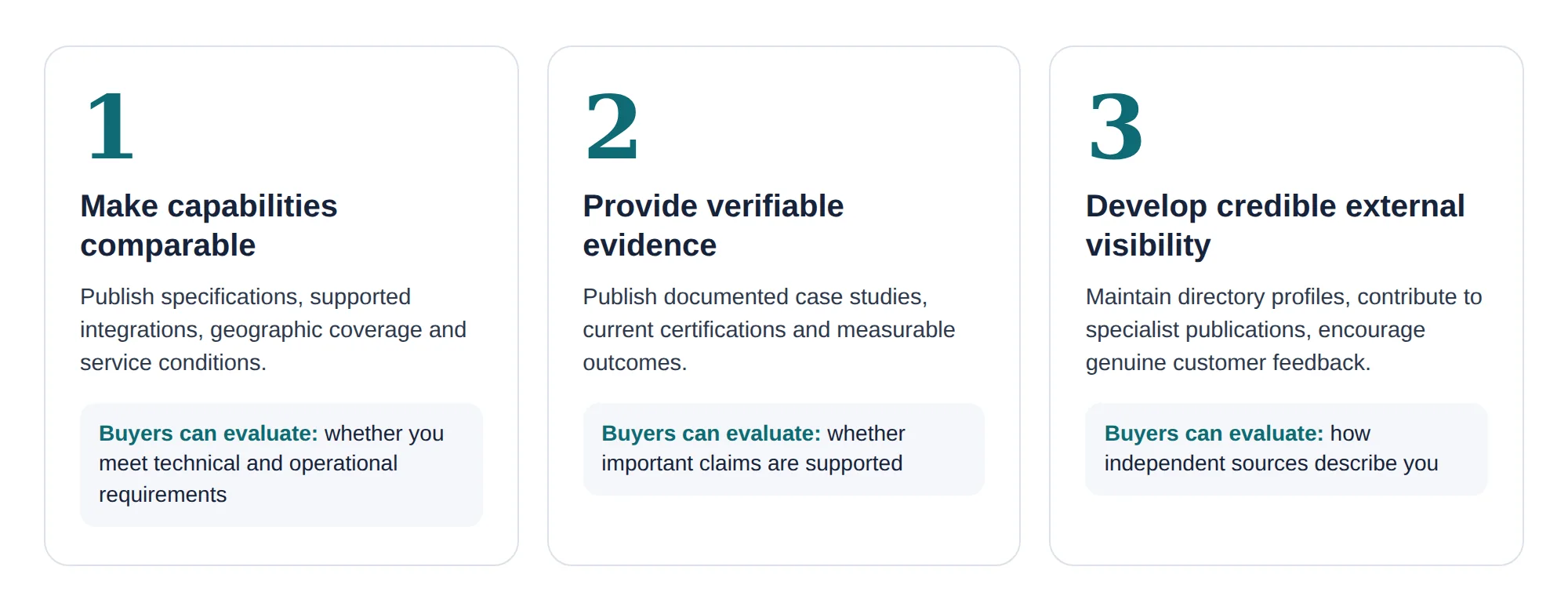
1. Publish information that answers purchasing questions
A supplier’s website should address the questions buyers need answered during comparison.
For example, a cybersecurity provider might publish a technical overview covering deployment options, supported integrations, security certifications and implementation requirements. A logistics provider might provide detailed information about geographic coverage, delivery capabilities, tracking systems and service-level commitments.
Descriptive headings, focused FAQs and comparison tables make this information easier for buyers to locate and understand. They can also help search and AI systems identify relevant passages.
2. Support claims with evidence
A claim such as “trusted by leading enterprises” provides limited information without supporting evidence. A documented case study explaining the customer’s requirements, the solution implemented and the outcomes achieved is more useful for supplier evaluation.
Where appropriate, companies should also publish current certifications, technical documentation and independently verifiable performance information.
3. Build visibility beyond the company website
The 2026 Trendos findings highlight the prominence of independent and community sources among leading AI citations in IT and solutions services.
For companies in this market, maintaining accurate profiles on relevant professional directories, contributing to specialist publications and developing genuine customer references can complement owned content.
However, external visibility is not a guarantee of inclusion in AI-generated recommendations. Citation patterns vary by industry, system and query.
6. What are the limitations of ChatGPT in supplier selection?
ChatGPT can support research and comparison, but several limitations affect its use in procurement.
Limitation | Potential consequence | Recommended safeguard |
|---|---|---|
1. Outdated information | Incorrect specifications or service details | Check current supplier documentation |
2. Incomplete market coverage | Relevant suppliers may be overlooked | Combine AI with other research channels |
3. Unsupported claims | Misleading comparisons | Verify important statements against original sources |
4. Missing commercial information | Inaccurate cost comparisons | Request current quotations |
5. Limited access to operational data | Incomplete risk assessment | Conduct formal supplier due diligence |
6. Confidentiality risks | Exposure of sensitive purchasing information | Use approved AI tools and data-handling procedures |
These limitations are particularly important when purchases involve regulatory requirements, sensitive data, substantial financial commitments or complex implementation projects.
AI can help structure the evaluation, but it cannot replace the evidence required to establish that a supplier meets an organization’s purchasing requirements.
7. Frequently asked questions
1. Can ChatGPT identify new B2B suppliers?
Yes. ChatGPT can suggest potential suppliers and help buyers explore unfamiliar markets. However, its suggestions may be incomplete or outdated. Buyers should verify company information and use additional research channels.
2. Do B2B buyers use ChatGPT mainly for supplier comparison?
Recent research indicates that comparison is a prominent LLM use case in B2B purchasing. The available findings concern LLMs generally rather than ChatGPT exclusively, and they do not establish a universal pattern across all industries.
3. Can ChatGPT compare supplier quotations?
Yes. It can organize suitable quotation documents into tables, identify differences and highlight missing information. Buyers should verify calculations, commercial conditions and source documents before relying on the results.
4. Can suppliers guarantee that ChatGPT will recommend them?
No. AI-generated responses depend on the user’s question, available information and the system’s retrieval capabilities. Publishing useful, accurate and independently verifiable information can support discoverability and evaluation, but it does not guarantee recommendations.
5. Can ChatGPT replace procurement professionals?
No. It can assist with research, information synthesis and preliminary comparisons. Procurement professionals remain responsible for verification, risk assessment, negotiations and purchasing decisions.
Conclusion
Generative AI is becoming an additional tool in the B2B purchasing journey, particularly for comparing suppliers and organizing information during evaluation.
For buyers, ChatGPT can simplify research and help structure preliminary shortlists, provided that important claims are verified through reliable sources and direct supplier engagement.
For suppliers, the implication extends beyond initial discovery. Detailed documentation, comparable specifications, verifiable evidence and credible third-party visibility can help buyers evaluate companies during AI-assisted research.
Key takeaway The objective is not simply to appear in AI-generated recommendations, but to provide the information buyers need to make informed purchasing decisions. |
|---|
Research sources
Source | Publication | Evidence used |
|---|---|---|
2025 | LLM adoption, buying-stage usage and supplier comparison | |
May 2026 | Generative AI adoption and validation through sales representatives | |
August 2026 | Leading AI citation sources across industries; sponsored research | |
Product documentation | ChatGPT web search and citations |
Editorial note: The procurement workflow and logistics comparison are illustrative. Research on LLM adoption should not be interpreted as ChatGPT-specific evidence, and the citation study should not be generalized to every B2B sector.
Let’s discuss your strategy
Identify the search visibility and content opportunities for your business.